The Hundred-Page Machine Learning Book, Andriy Burkov, self-published, 2019
Another classic short introduction to a field of study

Most scientific and mathematical books published today are too long, and they tend to get longer with each subsequent edition. I have long sought out and collected short books on topics of interest. Ideally, these books are clear and concise and introduce interesting and important topics in around 100 pages. I have in mind books like Integration of Ordinary Differential Equations by E.L. Ince, Foundation of the Theory of Probability by A.N. Kolmogorov, Probability and Information Theory, With Applications to Radar, by P.M. Woodward, in other words the sorts of books that used to appear as Carus Monographs or Griffin’s Statistical Monographs and many other series. The best modern examples often appear in the “A Student’s guide to” series. Like the book under review, most of these books are closer to 150 pages in length than the nominal 100 pages.
It seems that I share some ideas with the author - he repeats two of my favorite quotations before the table of contents: George Box’s “All models are wrong, but some are useful.”, and Pascal’s “If I had more time, I would have written a shorter letter.” Pascal’s quote should be kept in mind by the authors or books - most initial drafts can be rewritten to increase clarity and decrease length. With many technical books now being published with little or no editing, they are becoming longer while clarity suffers.
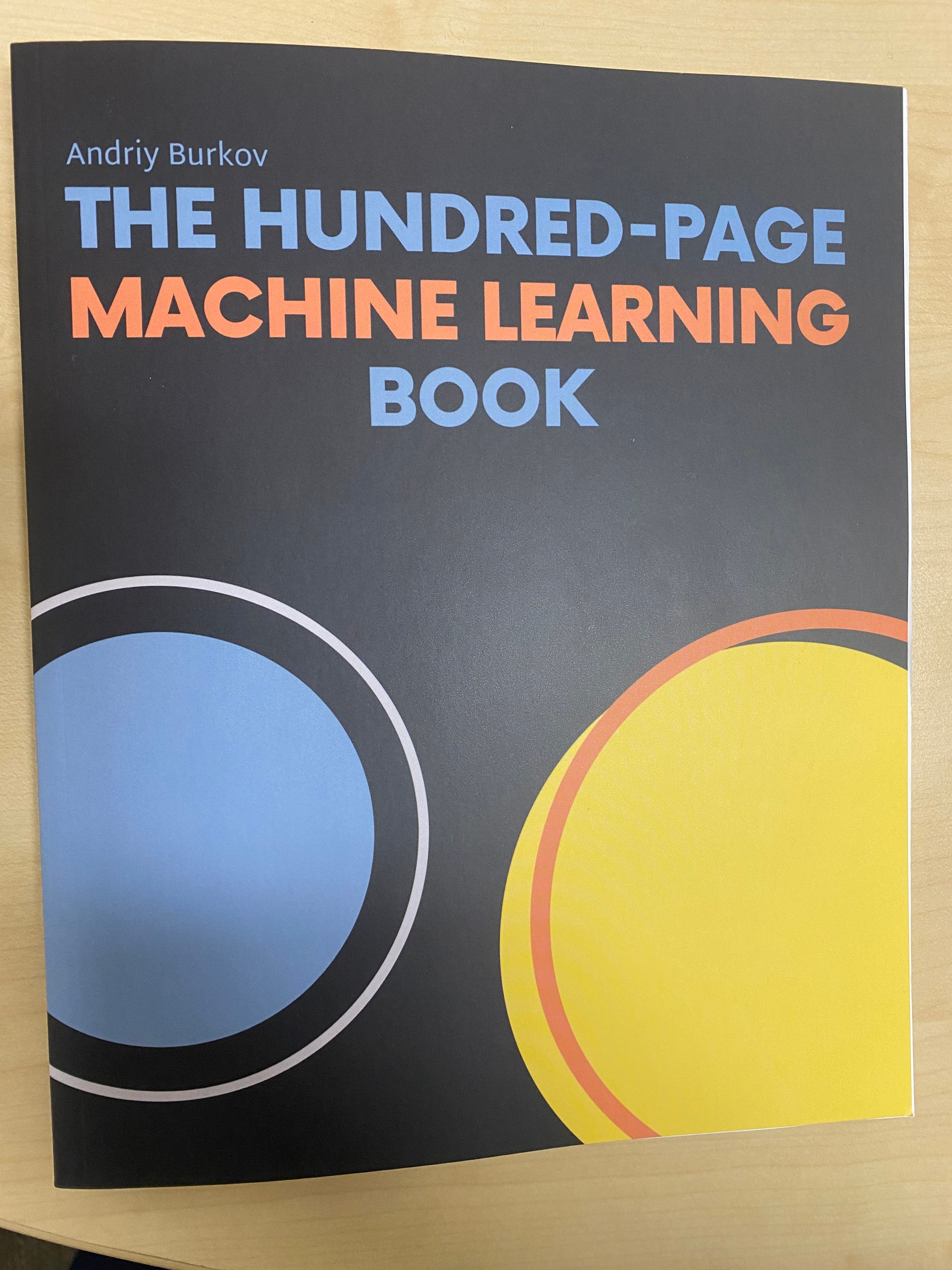
The present book is both clear and terse. I can say without reservation that I have never expected to find a hundred-page on machine learning that contained useful content, especially as it is a self-published book available through Amazon. Make no mistake, this is a great book - and it introduces readers to the most useful topics in Machine Learning in less than 150 pages. You can find out more about it at and ways to ensure that you get a real copy from the book’s website.
The main text begins with an introductory chapter that reviews the major features of machine learning, a chapter on notation and definitions follows. This second chapter reviews notation for sets, vectors, functions and operators, has sections on random variables, unbiased estimators, Bayes’ rule, parameters and hyperparameters, classification, regression, and more review of learning. This is followed by a chapter on fundamental algorithms, and another on the anatomy of a learning algorithm. There is then a chapter about the basic practices of machine learning. This is followed by a chapter on neural networks and deep learning. Then there is a chapter on problems and solutions, a chapter on advanced practice, and then chapters on unsupervised learning and others forms of learning. The final chapter summarizes some basic properties of things that were not covered in the book.
If you want a good introduction to machine learning - look no further. If you need further convincing, visit the webpage - you can download individual chapters there.